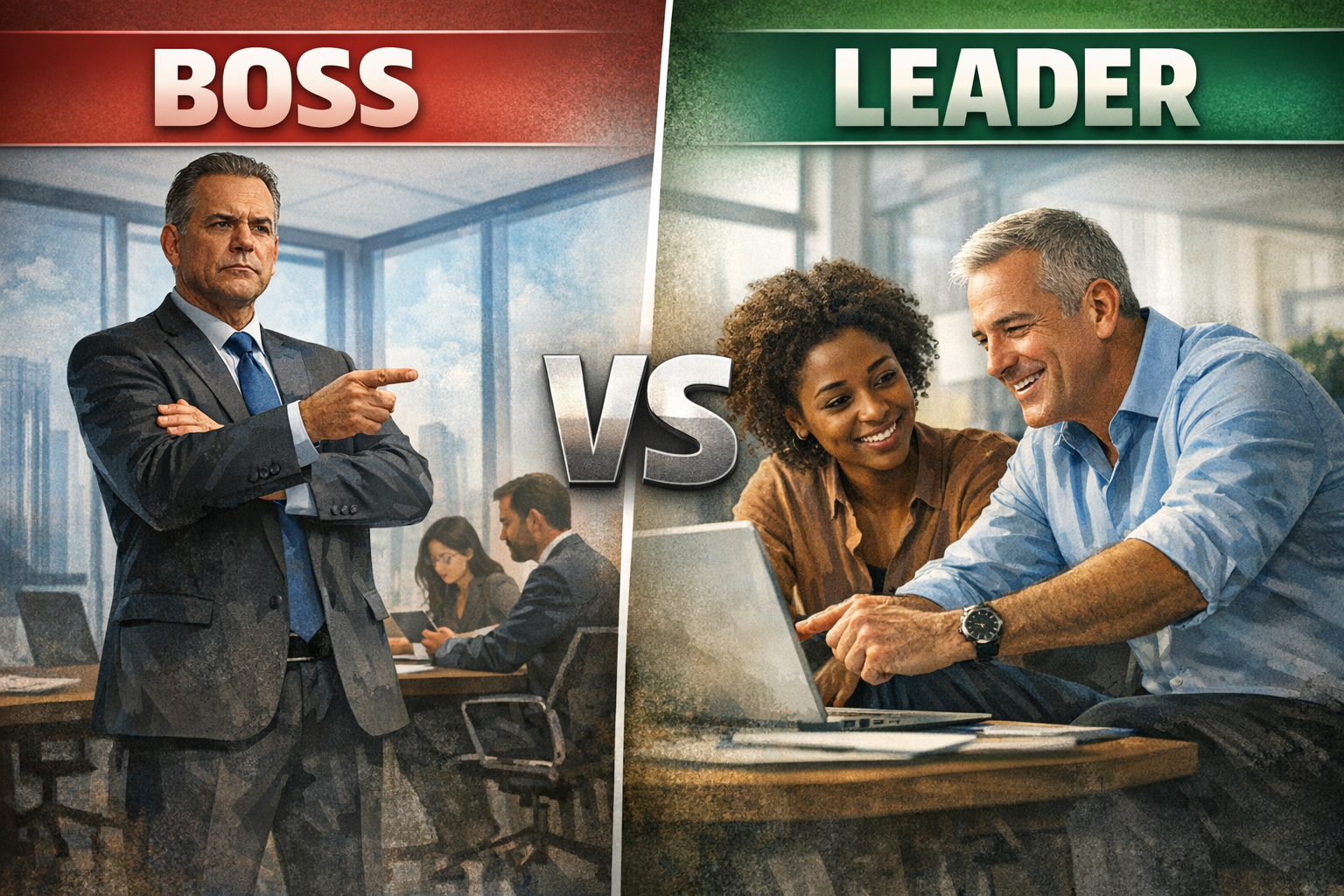
The difference between a leader vs boss is not a matter of title, seniority, or tenure. It is a matter of behavior — specifically, how a person uses the authority they have been given. And that behavioral gap has a direct, measurable impact on team performance, employee retention, and organizational growth.
Gallup’s ongoing workplace research shows that employees who describe their managers as leaders rather than bosses are significantly more engaged, more productive, and far less likely to leave. The cost of getting this wrong is not theoretical. It shows up in turnover rates, absenteeism, and revenue that never materializes.
So which are you — a boss or a leader? And what, exactly, is the difference?
The Core Difference Between a Leader vs Boss
At the most fundamental level, a boss manages through authority. A leader leads through trust.
When someone operates as a boss, their power comes from the organizational chart. They have a title, they have oversight, and they use both to control behavior. The relationship is transactional: do what I say, or face consequences. Compliance is the goal, and fear is often the tool.
When someone operates as a leader, their influence comes from trust. People follow them not because they are required to, but because the leader has consistently demonstrated that following them leads somewhere worth going. Commitment replaces compliance. Results follow.
This is not about being soft or overly agreeable. The strongest leaders hold people accountable, make hard calls, and deliver difficult feedback. The difference is how they do it — and why their people show up fully engaged instead of just showing up.
7 Key Behaviors That Separate a Boss vs Leader
1. How They Handle Accountability
Bosses assign blame. When something goes wrong, the instinct is to identify who failed and make the consequences visible — often publicly. This creates a culture where people conceal mistakes rather than surface them early, which means problems compound before anyone is willing to address them.
Leaders build accountability systems. They set clear expectations upfront, establish regular check-ins, and when things go sideways they diagnose before they judge. What went wrong? How can we learn from this? What needs to change? Accountability becomes a discipline, not a threat.
2. How They Deliver Feedback — Boss vs Leader in Real Time
Bosses criticize — in the moment, often publicly, focused on what was wrong without clear guidance on what right looks like. The result is defensiveness, not development.
Leaders coach. Feedback is specific, timely, and delivered privately. It is anchored in behavior, not character. The goal is to make people more capable. According to Dr. Rick Goodman, a leadership keynote speaker and executive coach who has worked with organizations across 32 countries, the most effective leaders understand that feedback is not about making people feel bad — it is about making people better.
3. How They Make Decisions
Bosses centralize every significant decision, creating bottlenecks and training their teams to stop thinking independently. Over time, talented people learn to bring problems instead of solutions. Dependence becomes the default.
Leaders distribute ownership. They define clear guardrails and trust their teams to operate within them. The people closest to the work typically have the most relevant information. Good decisions made by empowered teams consistently outperform theoretically perfect decisions made by overloaded executives.
4. How They Communicate — A Core Leadership vs Management Distinction
Bosses broadcast. They issue directives and expect compliance. Listening is treated as optional, and context is rarely shared. People know what they are supposed to do but not why — which means they cannot adapt intelligently when circumstances change.
Leaders create genuine dialogue. They communicate context alongside directives. They explain the reasoning behind decisions because people execute better when they understand purpose. And they listen actively because the real problems in any organization are rarely visible from the top.
5. How They Develop Their People
Bosses extract what people can do today. Training and development are treated as costs to be minimized — the first budget items cut when things get tight.
Leaders invest in development as a strategic priority. Developing the people around you is the highest-leverage activity available to any executive or manager. When your team gets better, your whole organization gets better. The return compounds over time in ways that no operational efficiency initiative can match.
6. How They Handle Failure
Bosses punish failure. This is the single fastest way to eliminate risk-taking, experimentation, and innovation from an organization. When people know that failure leads to punishment, they stop attempting anything that might not work — which means they stop doing anything genuinely new.
Leaders treat intelligent failure as data. They distinguish between careless mistakes and thoughtful experiments that did not produce the expected result. The former warrants correction. The latter warrants analysis and — frequently — recognition for the initiative that produced it.
7. How They Show Up Under Pressure — The Defining Leader vs Boss Moment
Bosses tighten control when things get hard: more oversight, more meetings, less autonomy. The implicit message is, “I do not trust you to handle this.” That message produces exactly the opposite of what the situation requires.
Leaders lean into clarity under pressure. They communicate more openly, define priorities more sharply, and give their teams what they need to navigate uncertainty independently. The message is, “Here is what we know, here is what we are doing, and I trust you to execute.” That message unlocks performance. The other one suppresses it.
Leadership vs Management: Not the Same Conversation
Management is a function. It encompasses planning, organizing, staffing, and operational control. Done well, it creates the systems an organization needs to perform consistently. Management is necessary and valuable.
Leadership is a relationship. It is the capacity to influence people’s behavior toward a shared goal in a way they internalize and genuinely commit to — not simply comply with. Leadership produces discretionary effort. Management produces task completion.
The best executives do both. They manage systems and lead people. The mistake most organizations make is promoting high-performing individual contributors into management roles without developing their leadership capacity — and then treating the resulting performance decline as a people problem rather than a development failure.
This is the exact gap that leadership development programs and executive coaching are designed to close. The transition from boss-style management to genuine leadership is not automatic. It requires intentional development, honest feedback, and consistent practice.
Why the Leader vs Boss Gap Matters More Now Than Ever
Remote and hybrid work has eliminated the ability to monitor performance through physical presence. Command-and-control management does not scale across distributed teams. Leaders who relied on visibility to enforce accountability find their teams drifting the moment no one is watching.
Professionals entering the workforce over the last decade have higher expectations of the people who manage them. They want transparency, genuine development opportunities, and a clear sense that their contribution matters. They leave organizations where they feel managed rather than led — and the retention data confirms it is already happening at scale.
As AI automates more routine cognitive tasks, the human contribution in most organizations is becoming increasingly strategic, creative, and relational. These are precisely the domains where leader-style management outperforms boss-style management by the widest margin.
The One Question That Tells You Which One You Are
Think about the last time something went wrong on your team. Did you respond in a way that made the person involved more capable and more confident going forward? Or did you respond in a way that made them more careful and more afraid?
That answer tells you more about the boss vs leader question than any formal assessment. And if the answer points toward boss behavior, the path forward is clear: leadership is a learnable skill set. Leaders are built far more often than they are born.
This article was prepared by the Thought Leaders Journal editorial team. For additional resources on leadership development, executive coaching, and building high-performance organizations, visit rickgoodman.com.